


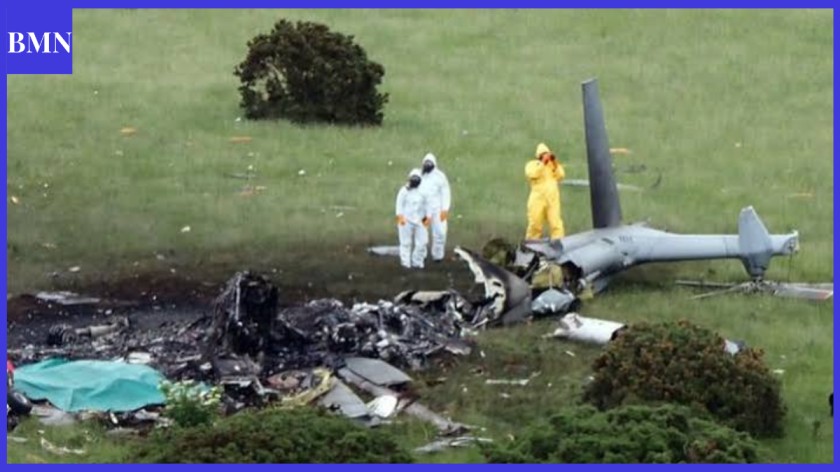
The Royal Navy helicopter crash in Devon on 3 June 2026 killed three service personnel during a training exercise. The Merlin Mk4 aircraft came down near Sourton Down, close to Okehampton. The tragedy prompted tributes from military leaders, families and colleagues across the country.
Investigators began examining the circumstances surrounding the crash, while police asked the public not to share photographs or videos of the wreckage online. In July 2026, a coroner opened inquests into the three deaths. The hearings marked an important step in the formal investigation, but they did not establish the precise cause of the accident. This guide explains what happened, who died, what investigators have confirmed and how the Devon incident differs from an earlier Merlin crash off Dorset.
What Happened in the Royal Navy Helicopter Crash?
The crash happened during the early hours of Wednesday, 3 June 2026. Devon and Cornwall Police received reports at around 3:45am after a Royal Navy helicopter crashed into a field at Sourton Down, near Okehampton. Emergency services attended the scene, alongside Ministry of Defence personnel. Police later confirmed that all three people aboard the aircraft had died.
The aircraft was a Merlin Mk4 helicopter linked to the Royal Navy’s Commando Helicopter Force. The crew were taking part in a training exercise when the accident occurred. Authorities notified the families of the three personnel and asked the public to respect their privacy.
The crash led to road closures in the surrounding area. These included sections of the A386 and access roads near the A30 at Sourton Cross. Authorities later lifted the closures after emergency crews completed their work at the scene. Police also asked anyone with relevant footage to provide it to investigators rather than post it online.
The incident caused deep sadness across the Royal Navy and the wider armed forces community. Military leaders paid tribute to the three personnel and recognised their commitment to service. Their families also shared messages that described their character, ambitions and the lasting impact they had on the people around them.
Where Did the Devon Helicopter Crash Happen?
The helicopter crashed at Sourton Down, a rural area near Okehampton in West Devon. The location lies close to Dartmoor and Okehampton Battle Camp, an area associated with military training. The site also sits between two important Royal Navy aviation bases in the South West: Royal Naval Air Station Yeovilton in Somerset and RNAS Culdrose in Cornwall.
Police responded shortly before 4am and secured the area while emergency services and investigators attended. The crash site lay in a field, and the authorities managed access while they dealt with the incident.
The surrounding roads formed part of the early response. Drivers faced temporary restrictions while emergency teams worked nearby. Those closures were later lifted, although the investigation continued beyond the initial response.
Sourton Down is important to understanding where the accident happened, but the location alone does not explain why the aircraft crashed. Investigators need evidence from the aircraft, the flight and other relevant sources before they can draw reliable conclusions.
Who Were the Three Royal Navy Personnel Killed in the Crash?
The three personnel who died were Lieutenant Commander Chris Gayson, Lieutenant Lily-Mae Fisher and Owen Green. The Royal Navy released their names on 4 June 2026 and shared details of their careers and the tributes from their families. Each had taken a different path into military aviation, but all had made a strong commitment to serving others.
Lieutenant Commander Chris Gayson
Chris Gayson was 42 and came from Somerset. He joined the Royal Navy in September 2008 after studying aerospace engineering at the University of Bath. He gained his pilot wings in October 2012 and served with 845 Naval Air Squadron, flying the Sea King Mk4 on deployments and operations that included Norway, Jordan and Afghanistan.
Gayson later worked in aviation safety and trained helicopter pilots at RAF Shawbury. He also held training and leadership roles before joining the Merlin conversion team. In July 2025, he became Operational Conversion Flight Commander with 846 Naval Air Squadron.
His family remembered him as a kind and gentle family man who loved his relatives and cared deeply about his work in the Royal Navy. His experience in aviation and training had made him a valued member of the service.
Lieutenant Lily-Mae Fisher
Lily-Mae Fisher was 31 and came from Surrey. She studied for a master’s degree in geology at Imperial College London before working in the energy sector. She joined the Royal Navy in 2019 after developing an interest in flying through university military organisations.
Fisher combined military service with a strong interest in sport. She represented Great Britain at the European Age Group Triathlon Championships in 2021. She also completed the All Arms Commando Course and became the only serving female Royal Navy Commando at the time, according to the Royal Navy’s account.
She joined 846 Naval Air Squadron in 2025 and was completing her final Merlin flying assessment when the crash occurred. She had expected to receive her pilot wings in June 2026.
Her family described her as an extraordinary woman who inspired others through her determination and willingness to take on challenges. They also asked for privacy as they dealt with their loss.
Owen Green
Owen Green was 24 and came from Hampshire. He joined the Royal Navy in January 2022 and trained at HMS Raleigh before continuing his aviation training at several Royal Navy and Royal Air Force bases.
Green earned his aircrewman wings in June 2025 and progressed to leading hand later that year. He completed an embarked aviation qualification aboard the Dutch amphibious ship HNLMS Johan de Witt in October 2025. His service also included exercises and operations in demanding conditions, including Arctic deployments.
His family remembered him as a caring son, brother, grandson and partner. They spoke about his warmth, kindness and pride in achieving his ambition to serve as a Royal Navy aircrewman.
The three biographies show the experience and commitment of the personnel involved. They also explain why their deaths affected their families, colleagues and the wider naval community so deeply.
What Is Known About the Cause of the Crash?
As of the latest publicly confirmed information covered in this article, the precise cause of the Devon crash had not been established in the official statements and inquest reporting reviewed. The Ministry of Defence confirmed that a full investigation was under way. It also said that it would be inappropriate to provide further details while the investigation continued.
An aircraft accident can involve several possible factors, including mechanical problems, flight conditions, maintenance history, operational decisions or a combination of circumstances. These are general areas investigators may examine; they are not confirmed explanations for this crash.
Investigators must assess the available evidence before identifying a cause. That work may include examining wreckage, aircraft systems, maintenance records, training procedures and other relevant information. Any final conclusions need to come from the investigation rather than speculation or unverified online claims.
Is the Merlin Helicopter Crash Cause Confirmed?
No confirmed cause appears in the official information cited here. The investigation remained ongoing when the Ministry of Defence answered parliamentary questions in June and July 2026. The opening of the inquests in July also did not establish the precise cause of death or the full circumstances of the accident.
Readers should treat claims about engine failure, pilot error or other specific causes with caution unless an authoritative investigation report supports them. A witness account may help investigators understand what happened, but it does not by itself establish the technical cause.
The most responsible account is therefore straightforward: the crash killed three Royal Navy personnel during training, and investigators must establish why it happened.
What Is the Latest Investigation Update?
The Ministry of Defence confirmed on 11 June 2026 that a full investigation into the crash was under way. In a written parliamentary answer on 1 July, the government repeated that the investigation continued and declined to provide further details while it remained active.
A major public development followed on 17 July 2026, when inquests into the deaths opened at Devon Coroner’s Court in Exeter. Reporting from the hearing stated that the personnel had been identified through dental records and that the precise causes of death had not yet been established.
Senior Devon coroner Philip Spinney adjourned the proceedings to allow further investigation into the circumstances that led to the deaths. An opening inquest is a formal stage of the coroner’s process; it is not the same as a completed hearing or a final finding.
For readers following the case, three points matter:
- The crash date and location: The accident occurred on 3 June 2026 at Sourton Down in Devon.
- The deaths: The Royal Navy named the three personnel who died and published tributes to them.
- The cause: The official information cited here does not confirm a final cause for the Devon crash.
A later investigation report or a concluded inquest may provide further detail. Until such findings become available, any claim that gives a definitive explanation should be checked against an official source.
What Happened at the Inquests?
The inquests opened in Exeter on 17 July 2026. The hearings formed part of the coroner’s legal process for examining the deaths. At the opening stage, the court heard that the three personnel had been identified through dental records and that their precise causes of death had not yet been established.
The coroner adjourned the inquests so investigators could continue examining the circumstances. This means the opening hearings did not deliver a final conclusion about how the crash happened or whether any particular factor caused it.
An inquest generally seeks to establish who died and when, where and how the death occurred, as well as the relevant circumstances. The process may involve evidence from witnesses, experts and official investigations. The exact steps depend on the case and the evidence available.
It is important to distinguish the coroner’s process from the technical investigation into the aircraft accident. The two processes may examine related evidence, but they serve different purposes. The coroner’s hearing does not automatically mean that investigators have finished their work.
Readers searching for inquest updates should look for reports that clearly distinguish an opening hearing, an adjournment and a final conclusion. This prevents early procedural developments from being mistaken for confirmed findings about the cause.
Tributes, Funerals and Remembrance
Following the crash, the Royal Navy shared tributes to the three personnel and published messages from their families. These accounts focused on their character, professional achievements and relationships with loved ones. Military leaders also expressed their condolences and recognised the loss felt by their colleagues.
The families described three individuals with different interests and career paths. Gayson had built a career in aviation and pilot training. Fisher combined her military ambitions with sporting achievements and a desire to inspire others. Green had worked towards his goal of becoming a Royal Navy aircrewman.
Such tributes provide a fuller picture of the people behind the news. They also help readers understand why the loss reached beyond the crash site and affected colleagues throughout the service.
For specific funeral dates, service arrangements or memorial events, readers should rely on confirmed statements from the families or the Royal Navy. Details can change, and it would be inappropriate to publish unverified arrangements. Respect for the families’ privacy remains important throughout the investigation and remembrance process.
What Is the Difference Between the Devon Crash and the 2024 Dorset Accident?
The Devon crash on 3 June 2026 was a separate incident from a Merlin Mk4 accident off the Dorset coast on 4 September 2024. The two cases involved the same helicopter variant, but they happened at different times and under different circumstances. Findings from one accident should not be treated as proof of the cause of the other.
In the 2024 incident, a Merlin Mk4 ditched in the sea during night training with HMS Queen Elizabeth, about 25 nautical miles south of Lyme Regis. Lieutenant Rhodri Leyshon died, while two other crew members survived. A later service inquiry reported a problem with a diaphragm in the engine fuel-pump assembly. The inquiry said the fault led to excess fuel flow and engine overspeed; it also made recommendations to address the issues identified.
Those findings relate to the 2024 Dorset accident. They do not establish what happened at Sourton Down in 2026. Investigators must assess the evidence from each incident separately, even when the aircraft type is the same.
This distinction matters because early online discussion can mix details from different accidents. Anyone searching for a “Merlin crash update” should check the date, location and aircraft involved before drawing conclusions.
What Is the Merlin Mk4 Used For?
The Merlin Mk4 is a military helicopter used by the Royal Navy’s Commando Helicopter Force to support the Royal Marines. Its design and equipment allow it to transport personnel and equipment and support amphibious operations. The aircraft has modifications that help troops deploy quickly, including a fast-roping beam near the main cabin door.
The Royal Navy also operates the Merlin Mk2, which has a different main role. The Mk2 primarily carries out anti-submarine warfare, while the Mk4 supports commando operations. Confusing these variants can lead to inaccurate descriptions of the aircraft involved in an incident.
Understanding the Merlin Mk4’s role helps explain why crews train for complex military tasks. However, the aircraft’s role does not reveal the cause of the Devon crash. That question depends on the evidence and the conclusions of the relevant investigation.
Royal Navy Helicopter Crash Reddit: How to Assess Online Discussion
Online forums and social media can help readers discover questions that other people are asking. They can also spread rumours, repeat incorrect details or combine information from unrelated incidents. Discussions on Reddit should therefore be treated as commentary unless a claim can be checked against a reliable source.
When assessing a post about the Devon crash, check whether it names the correct date and location. A claim about the 2024 Dorset accident, for example, should not be presented as a finding about the June 2026 crash.
Be cautious with purported eyewitness accounts, technical explanations and images of the wreckage. Police specifically asked people not to publish crash footage online and instead to share relevant material with investigators.
A useful approach is to compare online claims with official statements from the Royal Navy, Devon and Cornwall Police, the Ministry of Defence and the coroner’s court. If an important detail appears only in an unverified post, it should not be reported as fact.
Royal Navy Helicopter Crash Wiki: Finding Reliable Information
Readers may search for a wiki page or a general summary to understand the incident. Such pages can provide background, but the quality and freshness of their information may vary. For an ongoing investigation, official statements and court reporting are stronger sources for confirmed developments.
The Royal Navy’s published account provides the names and service histories of the three personnel. Devon and Cornwall Police documented the initial response and location. Parliamentary answers confirm that the Ministry of Defence was conducting a full investigation, while reporting from the inquests explains the legal process and its status at the opening hearing.
A reliable summary should separate confirmed facts from unanswered questions. It should also include dates so readers can tell whether an update reflects the first hours after the crash or a later stage of the investigation.
The key point remains that the Devon accident killed three service personnel, but the sources cited here do not establish a final cause. Readers should look for a later official report or concluded inquest before accepting claims that the investigation has reached a definitive answer.
- Also Read. Denise Welch Age Family Famous TV Roles
(FAQs)
When Did the Royal Navy Helicopter Crash Happen?
The crash occurred during the early hours of Wednesday, 3 June 2026, during a Royal Navy training exercise near Sourton Down in Devon. Police received reports at around 3:45am. <Cite refs={[“turn713006search2″,”turn713006search0”]} />
Where Did the Devon Helicopter Crash Happen?
The aircraft crashed into a field at Sourton Down, near Okehampton in West Devon. The area lies close to Dartmoor and Okehampton Battle Camp. <Cite refs={[“turn713006search2″,”turn713006search3”]} />
Who Died in the Crash?
The three personnel were Lieutenant Commander Chris Gayson, Lieutenant Lily-Mae Fisher and Owen Green. The Royal Navy published their names and service histories on 4 June 2026. <Cite refs={[“turn713006search0”]} />
Has the Cause of the Crash Been Confirmed?
The official information cited in this article does not establish a final cause for the June 2026 crash. The Ministry of Defence confirmed that a full investigation was under way, and the inquests opened in July. <Cite refs={[“turn713006search1″,”turn713006search4”]} />
Was the 2024 Dorset Merlin Crash the Same Incident?
No. The 2024 accident occurred at sea off Dorset during night training and involved a separate aircraft incident. Its investigation findings do not establish the cause of the 2026 Devon crash. <Cite refs={[“turn713006search5″,”turn713006search3”]} />
What Is the Latest Investigation Update?
The inquests opened at Devon Coroner’s Court in Exeter on 17 July 2026 and were adjourned to allow further investigation. The sources cited here do not confirm a final finding on the cause. <Cite refs={[“turn713006search4”]} />
Did the Royal Navy Merlin Mk4 Return to Flying?
Contemporary reporting stated that the Royal Navy authorised Merlin Mk4 flights to resume on 10 June 2026 after reviewing initial evidence. That decision did not establish the cause of the Devon crash or replace the full investigation.
Conclusion
The Royal Navy helicopter crash near Sourton Down was a tragic loss of three service personnel during a training exercise on 3 June 2026. Lieutenant Commander Chris Gayson, Lieutenant Lily-Mae Fisher and Owen Green each brought experience, ambition and commitment to their service. Their families and colleagues continue to remember their lives and achievements.
The investigation and coroner’s process are essential to understanding the circumstances of the crash. The inquests opened in Exeter in July 2026, but the official information cited here does not establish a final cause. The 2024 Dorset Merlin accident remains a separate case, with its own findings. Readers should rely on verified official updates and avoid treating speculation as fact. A careful, evidence-led account respects the families while helping the public understand what is known and what remains unanswered.